
Where Do We Go From Here?
Where Do We Go From Here: In the Age of AI

Setting The Stage: Where We’re At
Things definitely feel different. The air, the environment we are in.
This post is going to be a little different.
Apart from working in Cybersecurity, and detection engineering, I have a background in Econ, and have always been interested in all things economics.
I was reading the other day of the upcoming SpaceX IPO, and a few other high ticket ones.
This led me to tie in some thoughts I’ve had brewing for a while.
I think this represents a big moment in human history and not only for space exploration. It also could be another tipping point in the divide that we’re seeing.
The k-shaped economy if you will.
Think, hundreds of employees who are likely to become wealthier than ever imagined. Most living in a concentrated area (granted they could always choose to move) and this creates a massive influx of housing demand, luxury demand and inflow of dollars into the system.
Remember 2020? The definition of inflation is an increase in the money supply in the system. (From Investopedia)
Whether this is by government means or means of the free market, the result can be the same: an influx of money into the system equals an increase in price of goods, resulting in a loss of purchasing power for the rest.
Could we be going into this further bifurcation of the economy, where the upper middle class become Elite, and the almost non-existent middle class is squeezed lower and lower?
I don’t have the answer to that right now, and I’m trying to stay positive. But all of this does lead you to think about where we’re headed.
Zooming out and thinking through things holistically on where we’re at.
Events like Andrej Karpathy joining Anthropic being likened to KD joining the 73-9 Warriors on Twitter, while on the other end of the spectrum a lot of talented people are still looking for work after mass layoffs continue.
Not to mention, the many looking for their first gig in the field after finishing school.
I read this piece about this recently, and a lot of it resonated with my thoughts here.
If the pipeline for entry level talent is going away, where do they go?
We’re just going to pull the ladder up?
Stepping back into the view of society, on one hand, you have somebody who’s used ChatGPT to rewrite some stuff, or prompts away with their questions similarly to how they used to use Google.
And on the other, you have employees at these companies who make the models heading into multi-generational wealth.
Of course, you have the Techno-Optimist theory, that there will be so much abundance because of these advancements that work will look entirely different.
This tends to combat the Universal Basic Income theory where people become “work-optional”, and only chase opportunities if it aligns with their passions. With a guaranteed floor, their basic needs are covered and in theory can wait for the right fit for them.
But if history and economics has taught us anything, it’s that there is no free lunch.
(More on that later)
AI & The Learning Muscles
Then there’s the learning aspect on many people’s minds.
If AI ends up being the layer that abstracts learning away, what happens to the average internet user?
Long story short, you don’t want to outsource working those learning muscles that you develop over time.
Just how you wouldn’t give up working out entirely because you got in shape, doesn’t mean you can go away from “traditional” learning.
We’re not at Matrix levels yet (uploading skills directly to brain)
Let’s say you read the CliffsNotes of a book. You get the gist of it, and can form an opinion on the book, but if you read it cover to cover there’s a level of understanding that comes with it that is hard to replicate.
This is how I would liken to what we’re seeing.
A lot can happen in a year. It turns out a world of change can happen in two.
Where people were celebrating “ChatGPT rewriting their emails” just a few years ago, many now are seeing the other side of the deep end.
See this for reference

Take Meta’s “Model Capability Initiative” as just one case study.
Not to get all doomsday, but examples like these make it like there’s no turning back.
In a world where AI can generate most code, solve most deterministic problems, and overall can produce a lot of output, how do you balance being “AI native” and having the right amount of muscle memory, when interviews still want traditional (no google, no AI) interviews?
Will those muscles atrophy?
Something to think about as we strive to keep those learning muscles.
The True Impact AI Has Had
On one end, we have comments like the ones from Take-Two CEO Strauss Zelnick (GTA 6) on the impact AI has had.
As said in the interview above “Datasets by their very nature are backward looking, creativity by their very nature is forward looking”
A really clear way of putting it.
Used together, and we can really have something.
Has/will AI lead to a novel idea?
Or are they just really good next token predictors?
No good discussion is complete without the counter. Which leads to the notion of “AI psychosis”. Something we have seen from many CEO’s and thought leaders in recent times.
Where they go all in on AI, at any cost (more on this later).
Look, sometimes they mean well. But a lot of times this kind of behavior is indicative of someone who knows enough to sound right, but not enough to justify their talking points and a real conversation with someone who has done the work.
I’m sure you’ve seen it before, somebody who knows just enough to where it sounds like they know what they’re talking about... Only to be too far removed from the deep hands-on work to know the nuance and the sweat equity necessary to make an informed decision on a problem.
Like most practitioners, we’ve seen where the demo stops and the real system begins. Where real nuance equals having something valuable in your environment.
In today’s world, this is a real skill. Being able to manage yourself amongst all the noise. Spotting out true value.

“Mastering others is strength. Mastering yourself is true power.”
-Lao Tzu
With more content and noise than ever, this is a tall task but still doable.
Magnifica Humanitas
Then, there’s an elephant in the room.
Pope Leo Leo XIV released an encyclical on Monday. A letter aimed at preserving humanity in the age of AI. Not gonna lie, it shook me.
Mainly because I’ve been sitting with the thoughts mentioned here in this newsletter post for a while, and to see it said in this way was profound.
After reading this in its entirety, I can say that it really does seem like we’re at the inflection point.
No I’m not talking about AGI, I’m talking about what’s going to happen to the majority of people if we continue on this path. If the advancements of the past year continue at this pace, with disregard of the second order and third order effects, where do we end up?
The fact that this happened with the Pope next to Anthropic cofounder Christopher Olah makes this feel even weirder.
We are objectively in a strange timeline.
The question the letter is looking to raise is, where does humanity go from here? If we have the labs and a select few elite steering the ship, where does everyone else get a say?
No amount of model releases, no amount of hyper-scaler partnerships, can answer this question. They just kick the can down the road. Shiny object syndrome on a level we haven’t seen before.
What does the average person think about all these advancements?
In one datapoint, we have things like DuckDuckGo seeing a surge in users. What looks like rejection of the recent overhaul by Google, where AI overview takes precedence over the previous “10 blue links”.
Then there’s the data center debate, with many people in uproar about the expansion of these.
With 40,000+ acres being planned for the largest project of its kind in Box Elder County, Utah.
Many other debates follow these topics that the average person not in tech can tell you about.
Are we really in that big of a bubble?
Where most outside of Silicon Valley do not want AI as widespread as it has been pushed, and want a more human experience?
If we go up the stack, companies are also seeing that not everything is as it seems in their rose colored glasses with their AI push. Realizing that their expectations, and what is taking place might not be aligned.
Turns out “tokenmaxxing” was not the way.
Take this chart from Cloud Zero for example.
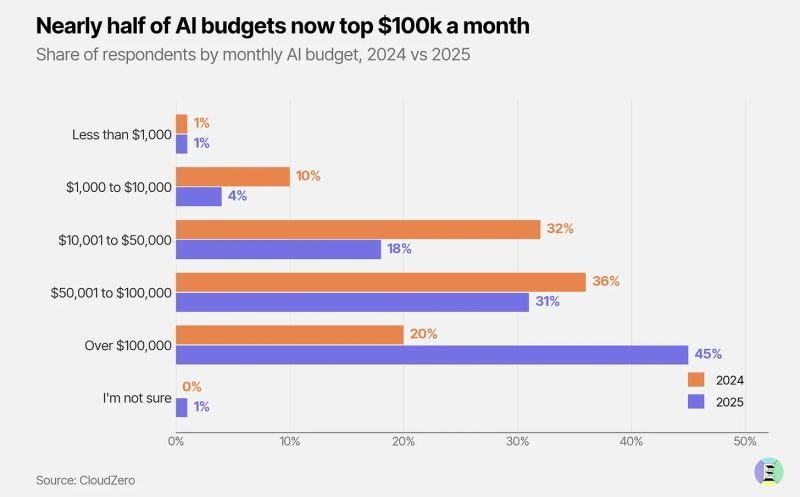
Just in the US, the average monthly spend on AI by large enterprises grew 36% between 2024 and 2025.
Microsoft recently stated they are moving away from Claude Code in the Enterprise, opting to double down on their Copilot models. What could also be seen as a cost reduction.
This makes me think of the latin phrase “Nullum gratuitum prandium”, an adaptation of the economic idiom “there is no such thing as a free lunch”.
At the end of the day, these models we interact with cost $$ to run, and following that thread we see the price is more than we think, as seen above.
Who’s going to foot that bill?
What I Read This Week
Apple Rejected 2 Million App Store Submissions in 2025 for Security and Fraud Prevention
Apple rejected 2 million app store submissions and transactions that would’ve accounted for over $2.2 billion in potentially fraudulent transactions
That means last year alone is equivalent to 20% of the past 6 years in fraud
Staged publishing and new install-time controls for npm
In efforts to combat the supply chain madness we’ve been seeing, GitHub adds staged publishing to npm
The added requirements include passing 2FA and explicitly approving a prebuilt tarball before a new package version becomes installable
Speaking of npm, this was a good read. If not for the thought exercise
With months of the same problem recurring, it’s hard not to sit down and rethink the way we have been doing things with package management
Queue this story from a while back. Still think about it constantly
Threat Model: Malicious Packages

I remember being in a security training once and the instructor went over an anecdote of discussing the concept of downloading packages to someone.
Perplexity Is Open-Sourcing Bumblebee
Bumblebee, a read-only scanner for protecting developer machines
In a moment where supply chain security is top of mind, this could be a great help in teams fighting back
Coverage includes package managers, AI agent configs, IDE extensions, and Browser extensions
Newsletter #197: What I Read This Week

This week we go over updates from the Cybersecurity community ranging from projects in Detection, Prevention, and AI.
MAGNIFICA HUMANITAS
ON SAFEGUARDING THE HUMAN PERSON IN THE TIME OF ARTIFICIAL INTELLIGENCEThe encyclical piece mentioned above on humanity and AI
Well explained and illustrations of where we’re at today if you have the time (42,000 words)
Netherlands seizes 800 servers of hosting firm enabling cyberattacks
This revolves around web hosting firm Stark Industries, founded in February 10, 2022, shortly before Russia’s invasion of Ukraine
These bulletproof-hosting takedowns increasingly depend on sanctions enforcement and the financial trail
Wrapping Up
This week, we zoomed out and looked at the field as a whole and where we’re at in the age of AI.
Where will we end up?
In a world where we don’t have the same meaning of work as today?
The pendulum is starting to swing the other way, and all I know is it’s not done swinging.
See you in the next one.
References
Don’t Outsource the Learning

DuckDuckGo installs are up 30% as users reject being ‘force-fed’ Google’s AI Search
Inflation: What It Is and How to Control Inflation Rates
Microsoft’s quiet Claude Code retreat and the real cost of enterprise AI
MAGNIFICA HUMANITAS
ON SAFEGUARDING THE HUMAN PERSON IN THE TIME OF ARTIFICIAL INTELLIGENCE